
Get In Touch
- Phone 0321-6775087
- Email iqwrite095@gmail.com
- Address Multan, Punjab, Pakistan
- Follow us

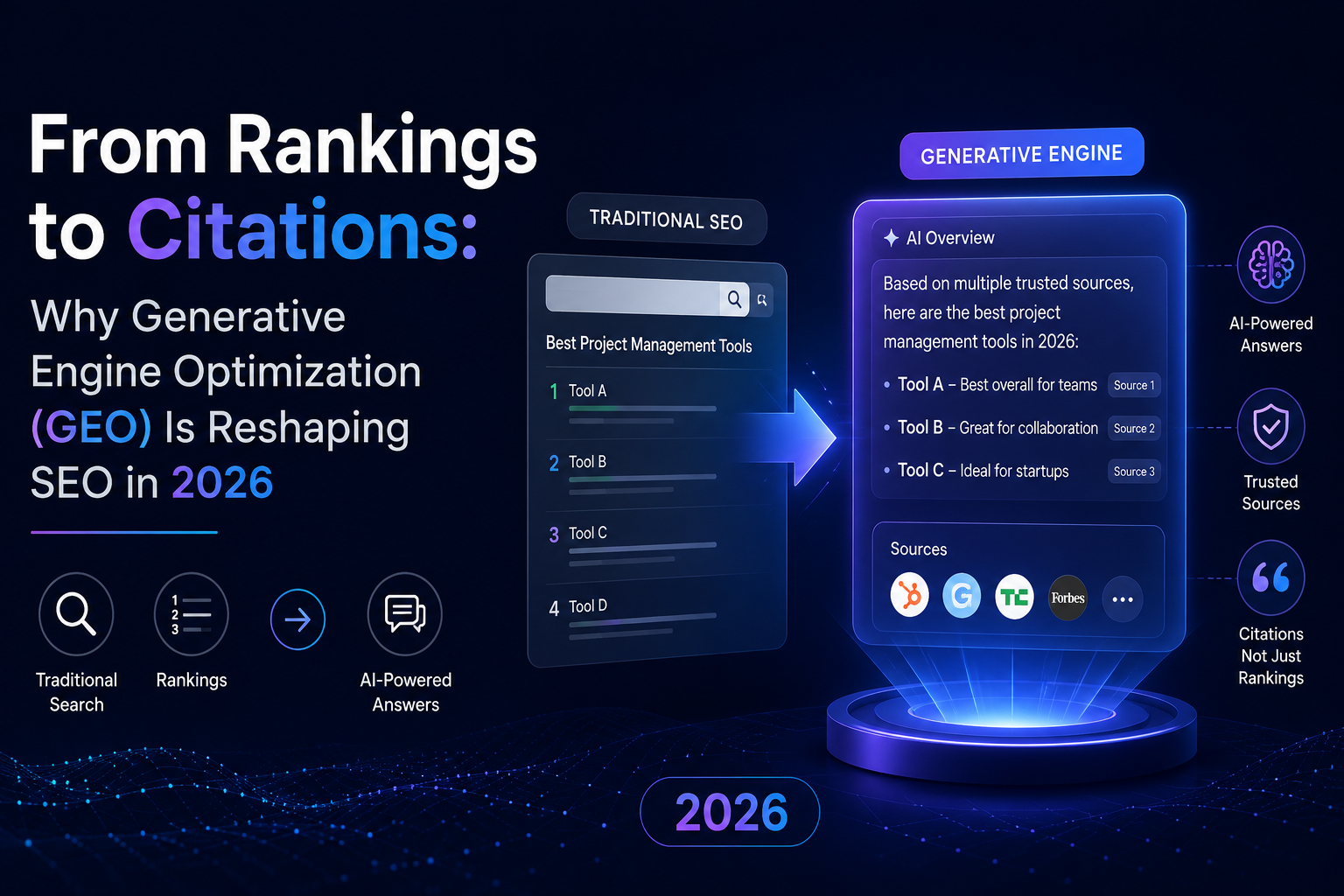
From Rankings to Citations: Why Generative Engine Optimization (GEO) Is Reshaping SEO in 2026
For almost two decades, ranking on page one of Google was the finish line. Get the keywords right, build the backlinks, and optimize the meta tags, and the clicks will follow. That playbook isn’t dead, but it’s no longer the whole game.
A growing share of searches today never produce a click at all. Instead, they produce an answer: a synthesized summary from ChatGPT, Google’s AI Overviews, Perplexity, or Copilot, built from a handful of sources the AI decided were trustworthy enough to cite. If your content isn’t one of those sources, you’re invisible in that conversation, no matter how well you’d have ranked in the old “ten blue links” model.
That’s the discipline now known as Generative Engine Optimization (GEO), and understanding how it works and how it relates to the SEO fundamentals you already know is quickly becoming a core skill for marketers, not an optional add-on.
What Is Generative Engine Optimization?
GEO is the practice of structuring content so AI-powered search and chat platforms can find it, trust it, and cite it when generating an answer. Where traditional SEO optimizes for ranking position and click-through, GEO optimizes for something different: being one of the small number of sources, often just two to seven that a generative engine references when it answers a user’s question directly.
The distinction matters because the two systems reward different things:
- Traditional SEO — optimize for keyword relevance and backlink authority → earn a ranking position → earn a click → convert the visitor on your site.
- GEO — optimize for fact density, structure, and demonstrable authority → earn a citation inside an AI-generated answer → build brand recognition and trust, often without a click at all.
It’s worth noting that Google itself pushes back on treating GEO as a separate discipline requiring special hacks. Google’s own developer guidance is blunt: things like “chunking” content or creating special AI text files such as llms.txt don’t move the needle for Google Search, because Google doesn’t use them. Its position is that optimizing for generative AI search is still fundamentally SEO, just refocused on what genuinely helps both human readers and AI systems judge content as unique, useful, and trustworthy.
That’s an important reality check for anyone selling “GEO hacks.” The core work expertise, originality, structure, and credibility hasn’t changed. What’s changed is which signals matter most, and what “winning” looks like.
Why This Shift Is Happening Now
A few forces are converging to make 2026 the year GEO stopped being optional:
AI search has real, growing usage. Platforms like ChatGPT now handle well over 100 million queries a day, and Google’s AI Overviews appear across billions of searches monthly. This isn’t a niche behavior anymore; it’s becoming a primary way people get answers.
Search volume itself is shifting. Some analysts project a meaningful decline in traditional keyword-style search volume over the next few years as more queries get resolved directly inside an AI answer. That doesn’t mean classic search disappears — it means a growing share of demand is being served through a different interface.
The traffic that does convert converts better. Visitors who arrive at a site after an AI has already answered their basic questions tend to be further along in their decision-making pre-qualified, in a sense, by the AI itself. That makes every page a potential conversion opportunity, not just dedicated landing pages.
Citation is a stronger trust signal than ranking. Being named directly inside an AI’s answer functions like an implicit endorsement arguably a stronger signal of authority than sitting at position three on a results page most users don’t scroll past position one to see.
The Five Principles Behind GEO in 2026
Across the current best-practice guidance from SEO practitioners and platforms, a consistent set of principles keeps showing up:
1. Answer real questions in the way people actually ask them. Generative engines mirror natural, conversational phrasing rather than clipped keyword strings. Researching the exact questions your audience asks through tools like Google Search Console, community forums, or “People Also Ask” data and structuring content directly around those questions increases the odds an AI model pulls your page into its answer.
2. Build in fact density and citation-worthy elements. AI systems favor content they can quote confidently: original statistics, expert quotes, clear definitions, and verifiable claims. Independent research on AI visibility has found that adding well-sourced statistics, direct quotations, and citations to existing sources can meaningfully improve how often content gets pulled into AI-generated answers. If you’re not creating anything citation-worthy, original data, a proprietary framework, or expert commentary, there’s little reason for an AI to choose you over a dozen similar pages.
3. Structure content for machine parsing, not just human skimming. Clear headers that describe exactly what a section covers, bulleted and tabular formats, concise definitions, and dedicated FAQ sections all make it easier for an AI system to lift a self-contained, accurate passage from your page. This is really just good content structure, GEO just raises the stakes on doing it well.
4. Strengthen E-E-A-T signals—experience, expertise, authoritativeness, and trustworthiness. Generative engines are, at their core, trying to avoid citing something wrong. That makes trust signals—author credentials, demonstrated first-hand experience, transparent sourcing, and third-party validation more important, not less. Detailed author bios, credentials, and real case evidence all feed this.
5. Show up in the places AI systems already trust. AI engines don’t only crawl your website directly; they draw on the same signals SEO always has high-authority publications, established directories, review platforms, and digital PR coverage. Earning mentions and citations in outlets that AI models already treat as reliable — think trade publications, research databases, or well-known industry directories — is one of the more consistent ways to get picked up secondhand, even on pages you don’t own.
GEO Doesn’t Replace SEO — It Builds On It
The most important thing to understand is that GEO is not a replacement discipline. It’s an additional layer sitting on top of the same foundation SEO has always required: technical health, crawlability, fast load times, clean site architecture, and genuinely useful content. Every major GEO guide converges on the same point — you can’t shortcut your way to AI citations without the underlying SEO fundamentals already in place.
What GEO adds is a sharper focus on structure and trust signals specifically tuned to how generative engines retrieve and synthesize information, plus a new measurement problem: most marketing teams have years of Google Analytics dashboards and no equivalent visibility into how often they’re being cited inside AI answers. Building out that tracking citation frequency, response inclusion rate, and share of voice across ChatGPT, Perplexity, Gemini, and AI Overviews is quickly becoming its own line item in the marketing stack.
What This Means in Practice
If you’re managing content or SEO strategy heading deeper into 2026, a practical starting checklist looks like this:
- Audit your existing cornerstone content for freshness, generative engines weight recency, and a page last updated in 2023 will lose ground to a competitor’s 2026 refresh on the same topic.
- Add genuinely original material where you can — a small proprietary dataset, a client case study with real numbers, or expert commentary — rather than more generic, AI-generated summary content.
- Restructure key pages around the actual questions your audience asks, with clear headers and scannable formatting.
- Strengthen author and brand credibility signals, bios, credentials, and transparent sourcing across your most important pages.
- Start tracking AI citation performance alongside traditional rankings, even if the tooling is still immature.
None of this abandons the SEO fundamentals that already work. It just means the definition of “ranking well” has quietly expanded from a position on a results page to a mention inside an answer. The brands that treat GEO as an extension of solid SEO, rather than a separate set of hacks, are the ones positioned to compound their advantage as AI-mediated search keeps growing.